
È un abbraccio molto lungo: trent’anni e sei giorni. È un «gesto di pacificazione» tra due ex ragazzi cinquantenni, divisi da un dolore, finalmente riuniti dallo stesso dolore. È una stretta umana al’́inizio incerta, poi forte, che scioglie in pochi attimi il gelo dei decenni. «È un incontro tra uomini», dice Giovanni quando le parole riescono a risalirgli alle labbra, «niente di più, niente di meno». Quasi coetanei, quasi colleghi di lavoro, entrambi sposati, entrambi con figli che hanno più o meno l’ultima età che ebbe Francesco, entrambi impegnati in due diversi itinerari spirituali: due vite parallele e speculari. «È il momento che ho immaginato per anni», cerca le parole Massimo. Ce n’è una, di parole, che galleggia nell’aria, che attende di essere convocata. Quella parola è “perdono”, ma entrambi si accorgono, quasi sorpresi, di non averne bisogno. «Il perdono è solo di Dio», dice Giovanni, «e poi se io ora dicessi ‘ti perdono’, vorrebbe dire che finora ti ho pensato colpevole. Invece non è così. Quel giorno è stata sconvolta la vita di Francesco, ma anche la tua. Non sei stato tu il vero colpevole». Tramontani annuisce, comprende bene il senso di queste parole. C‘è un senso storico, perché Tramontani ricorda certo di avere sparato, ma non ha mai avuto la certezza che in quel fumo fitto sia stato proprio lui a colpire, o se fu invece qualcun altro che quel giorno vicino a lui forse sparò, chi può dirlo, nessuno può dirlo, Tramontani stesso dice di non saperlo, comunque nessun giudice fu messo in grado di deciderlo, per quel regalo avvelenato del proscioglimento per «uso legittimo delle armi». Ma non è di questo che si parla oggi nel silenzio del convento. In realtà quando Lorusso dice «non sei il vero colpevole» non pensa alle verità giudiziarie, pensa soprattutto alle dure morali della storia, alle responsabilità di chi aveva il potere di assumersele. Pensa a chi allora mise due ragazzi contro, due che non si conoscevano e non si odiavano, e lasciò, oppure volle, oppure mise in conto che uno ammazzasse l´altro; e ci fu anche chi, dopo, dannò la memoria di Francesco per salvare la propria. Giovanni ci pensa ancora qualche istante, e conclude: «Il nostro è un incontro fra due vittime». «Due vittime dello Stato», completa padre Benito. Al secolo Benito Fusco, per i compagni di un tempo Benito il rosso, militante di Lotta continua, oggi frate dell’ordine dei Servi di Maria.
L’11 marzo 1977 a Bologna, l’agente Tramontani sparò e lo studente Francesco Lorusso morì. Perchè? Come?
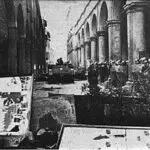
La sequenza di avvenimenti che portò all’uccisione di Lorusso si svolse nel reticolo di strade delimitato da via Irnerio, via Zamboni e via Mascarella, una parte importante della zona universitaria cittadina. Alle ore 10 di venerdì 11 marzo, alcune centinaia di studenti e docenti vicini al movimento cattolico Comunione e liberazione (CL) si riunirono per discutere sulla crisi dell’università e sui temi della condizione giovanile in un’aula dell’Istituto universitario di Anatomia in via Irnerio. La fruibilità degli spazi e il diritto di parola erano spesso oggetto di contesa durante le occupazioni delle facoltà, gli esponenti di CL intervenuti in passato nelle assemblee studentesche spesso venivano zittiti o cacciati dai giovani di estrema sinistra. Alcuni studenti di CL approntarono così un servizio d’ordine a protezione del loro incontro. Secondo alcune versioni, un piccolo gruppo di giovani di estrema sinistra tentò di entrare nell’aula e venne respinto; altri raccontarono che alcuni contestatori, dopo essere stati cacciati dall’aula, chiamarono rinforzi. La notizia della rissa, in ogni caso, giunse alle orecchie di studenti ed extraparlamentari del movimento che da via Zamboni e piazza Verdi raggiunsero in gran numero l’Istituto di Anatomia. Occupato il cortile esterno, strinsero d’assedio l’edificio, lanciando insulti e minacce agli studenti di CL che si barricarono nell’aula, chiamarono la polizia e fecero avvertire telefonicamente anche il rettore Carlo Rizzoli. Quest’ultimo fece giungere notizie allarmanti al questore Gennaro Palma che, d’intesa con il prefetto, decise di inviare in via Irnerio un contingente composto da carabinieri e da un reparto della celere. Funzionari dell’ufficio politico della questura giunti rapidamente sul posto avviarono un dialogo con i giovani del movimento, l’obiettivo era calmare gli animi, far allontanare gli assedianti verso porta Zamboni e permettere così il deflusso degli studenti di CL in direzione opposta. Durante le trattative arrivò l’autocolonna delle forze dell’ordine, gli uomini della celere rimasero in attesa sui mezzi, un gruppo di agenti, invece, a piedi si avvicinò al cortile per formare un cordone di sicurezza. Alcune studentesse iniziarono a uscire dall’aula di Anatomia, ma proprio quando la tensione sembrava sul punto di sciogliersi scoppiarono violenti tafferugli: gli agenti della celere lanciarono una carica improvvisa colpendo con i manganelli i giovani del movimento che stazionavano ancora nei paraggi del cortile, studenti e militanti di estrema sinistra risposero lanciando sanpietrini mentre ripiegavano verso porta Zamboni, altri armati di bastoni andarono allo scontro. Le forze dell’ordine sgombrarono definitivamente la zona sparando decine di candelotti lacrimogeni in tutte le direzioni. Tra scene di panico e nella concitazione generale, tutti gli studenti di CL riuscirono ad allontanarsi, dirigendosi velocemente verso piazza VIII agosto. Nel frattempo alcuni giovani del movimento si preparavano al contrattacco negli edifici universitari occupati tra piazza Verdi e via Zamboni. Si rifornirono di bottiglie molotov, preparate e nascoste nei giorni precedenti in vista di una manifestazione convocata per il 12 marzo a Roma. Un gruppo imboccò via Bertoloni e arrivò all’incrocio con via Irnerio invasa dal fumo, lanciò pietre e bottiglie incendiarie verso uomini e automezzi di carabinieri e polizia, quindi arretrò immediatamente inseguito dal lancio di altri lacrimogeni.
Massimo Tramontani, giovane carabiniere di leva, era giunto in zona alla guida di un camion dell’Arma e attendeva ordini dai superiori accanto al mezzo parcheggiato nei pressi dell’incrocio tra via Irnerio e via Centotrecento, strada parallela a via Bertoloni. Dopo aver schivato alcuni sassi lanciati dagli extraparlamentari, decise di reagire sparando con il suo fucile. Anni dopo, Tramontani ha ricostruito così quei momenti: «Sono mascherati e lanciano cubetti di porfido, io e due poliziotti facciamo salti per schivarli, poi loro provano a lanciare un lacrimogeno ma cade quattro metri davanti, gli studenti incoraggiati da questa figuraccia avanzano e continuano a lanciare. Sono molti, io sono solo, dov’è il capitano? mi chiedo, decido di reagire, sparo in aria col winchester. Ripeto: in aria […], voglio solo spaventare, infatti scappano» [5]. Nessuno rimase ferito, i proiettili andarono a vuoto, ma secondo Raffaele Bertoncelli, ex di Lotta continua presente nel drappello che attaccò da via Bertoloni, «mentre noi scappavamo, i carabinieri ci sparano colpi di fucile ad altezza d’uomo» [6]. Le molotov danneggiarono due automobili, una delle quali in dotazione alla polizia. Il contingente delle forze dell’ordine, ritenendo risolta la situazione nei pressi dell’Istituto di Anatomia, iniziò a ritirarsi percorrendo via Irnerio in direzione di piazza VIII agosto, dove era in corso l’affollato mercato settimanale di Bologna, la “Piazzola”. Mentre lo spostamento degli automezzi procedeva a rilento, poliziotti e carabinieri che seguivano a piedi notarono in via Centotrecento i movimenti di numerosi giovani e, temendo un nuovo attacco, li dispersero lanciando altri lacrimogeni. La seconda incursione contro le forze dell’ordine, tuttavia, si materializzò subito dopo nella strada parallela, via Mascarella, cogliendo di sorpresa l’autocolonna degli agenti, rimasta priva di buona parte della scorta appiedata.
Francesco Lorusso era nel gruppo di studenti ed extraparlamentari che, con cubetti di porfido e bottiglie incendiarie, si avvicinò di corsa all’intersezione con via Irnerio. Dopo una mattinata passata a studiare in casa di un amico, aveva raggiunto la zona universitaria e qui, saputo delle cariche e degli scontri davanti all’Istituto di Anatomia, si era unito ai compagni di militanza che intendevano reagire. Giunti al termine del portico di via Mascarella, alcuni tirarono sassi verso automobili e camion delle forze dell’ordine; Lorusso e il suo amico Beppe Ramina, invece, lanciarono due molotov: la prima si schiantò in mezzo alla carreggiata, l’altra colpì la portiera del camion condotto da Massimo Tramontani, causando un principio d’incendio all’altezza della cabina di guida. Terminato il blitz, Lorusso e gli altri extraparlamentari si diedero alla fuga sotto i portici di via Mascarella con l’intento di raggiungere via Belle Arti. Mentre alcuni agenti e un giornalista si adoperavano per domare le fiamme sul suo mezzo, Tramontani scese dal posto di guida, si portò al centro di via Irnerio e aprì il fuoco con la sua pistola Beretta calibro 9 in direzione dei portici di via Mascarella: «Scendo con la pistola e faccio fuoco verso i dimostranti. Ma senza l’intenzione di uccidere. […] Non voglio uccidere, dico, li voglio spaventare di più, visto che sparare in aria non serve. Sparo dove vedo che non c’è nessuno, verso i muri», dichiarò a «Repubblica» nel 1997.
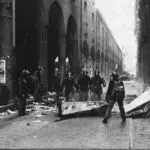
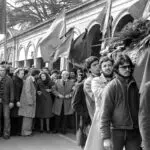
Esplose sei colpi, era la seconda volta che sparava quella mattina. Lorusso venne raggiunto da un proiettile che lo trapassò trasversalmente, penetrando nella regione anteriore sinistra del torace per uscire dalla schiena, nella parte posteriore dell’emitorace destro. Probabilmente, mentre fuggiva, si era girato per guardare cosa succedeva alle sue spalle: riuscì a fare ancora qualche passo in direzione opposta, quindi cadde all’altezza del civico 37 di via Mascarella e morì in pochi istanti. Gli altri extraparlamentari fermarono la loro fuga e si avvicinarono nel vano tentativo di soccorrerlo. Alcuni trascinarono il corpo verso via Belle Arti e chiesero aiuto ai negozianti e a un automobilista di passaggio per organizzare il trasporto al pronto soccorso. Poliziotti, carabinieri e lo stesso Tramontani non si occuparono di verificare le conseguenze degli spari e, ignorando l’accaduto, ripresero la marcia verso piazza VIII agosto, allontanandosi definitivamente dai luoghi degli scontri. Dopo minuti concitati, un’ambulanza entrò contromano in via Mascarella da via Irnerio, il corpo di Lorusso venne caricato a bordo e portato all’ospedale Sant’Orsola, ma ai medici non restò che certificare la morte del giovane. La notizia si diffuse rapidamente: Radio Alice, emittente vicina al movimento bolognese, la diede già alle 13.30. Piazza Verdi e le vie limitrofe, nel cuore della zona universitaria, si riempirono rapidamente di militanti della sinistra extraparlamentare e di amici di Lorusso, accomunati dalla rabbia e dall’esasperazione. I giovani attribuirono la responsabilità politica dell’uccisione di Lorusso alla Democrazia cristiana, maggiore partito dell’area governativa, e al suo esponente Francesco Cossiga, ministro degli Interni. Così, verso le 17, un corteo composto da migliaia di giovani del movimento risalì via Zamboni per attraversare il centro di Bologna e raggiungere la sede provinciale della Democrazia cristiana in via San Gervasio, dove militanti e componenti dei servizi d’ordine intendevano portare l’assalto con molotov, pietre e spranghe. Alcuni avevano con sé armi da fuoco. Durante il tragitto venne sfiorato lo scontro fisico con militanti del Partito comunista posti a presidio del Sacrario dei caduti partigiani e della sede comunale di Palazzo D’Accursio, vetrine e automobili furono distrutte, fino all’impatto con il contingente delle forze dell’ordine davanti alla sede della Dc. La folla di giovani, respinta a fatica, si divise in vari tronconi e accese focolai di guerriglia urbana in vari punti della città, contrastata dai lanci di lacrimogeni. Alla stazione ferroviaria vi fu un prolungato conflitto a fuoco con agenti di polizia. Infine, a sera, studenti ed extraparlamentari si radunarono nella zona universitaria dopo aver innalzato barricate.
La mattina dopo si tenne una manifestazione sindacale unitaria in Piazza Maggiore, protetta da un nutrito servizio d’ordine composto da iscritti al Pci. Centinaia di giovani arrivarono in corteo dalla zona universitaria e, in un clima di forte tensione, cominciarono le trattative per far parlare dal palco rappresentanti del movimento. L’accordo non venne trovato: gli organizzatori pretendevano una condanna delle violenze e dei danneggiamenti del giorno prima, gli extraparlamentari rifiutarono le condizioni rivendicando la legittimità della loro reazione. La manifestazione, così, si chiuse senza l’intervento di persone vicine a Lorusso, un nuovo strappo tra il Pci e il movimento.
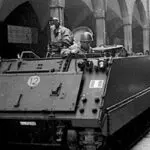
Nel pomeriggio le forze dell’ordine tentarono ripetutamente di sgombrare piazza Verdi e via Zamboni, ma furono sempre respinte dagli occupanti e di nuovo si sparò da entrambe le parti. Polizia e carabinieri riuscirono a prendere il controllo dell’area all’alba di domenica 13 marzo, entrando con i mezzi blindati nelle strade abbandonate ore prima dagli extraparlamentari. Un morto, numerosi feriti e parte del centro cittadino devastato da incendi e danneggiamenti: con questo bilancio si chiuse una pagina drammatica per Bologna.
Al termine di un lungo procedimento la Corte d’appello dichiarò la nullità dell’inchiesta di Catalanotti e ordinò l’immediata scarcerazione di Tramontani. Quest’ultimo, per la Corte, fu l’unico a sparare verso Lorusso, ma fece uso legittimo delle armi e per tale motivo non si poteva promuovere l’azione penale contro di lui. Pistolese venne prosciolto per non aver commesso il fatto.
Fonti
Bologna.repubblica.it
Lorusso e Tramontani un abbraccio dopo 30 anni | Bologna la Repubblica.it
Ladigacivile.it
L’uccisione di Francesco Lorusso
Approfondimenti
da Rai Play
Febbre 77 1980 – Primo piano – La morte lecita: l’uccisione di Francesco Lorusso – Video – RaiPlay
Wikipedia
https://it.wikipedia.org/wiki/Omicidio_di_Francesco_Lorusso
Ugo Maria Tassinari
Bologna, 11 marzo 1977: carabiniere uccide Francesco Lo Russo
Sound
Documenti sonori da radio Alice Voci
Video
La luna e il dito / Bologna 1977 – La storia siamo noi
da Wikipedia
da Wikipedia, la Diga Civile, Enrico Scuro, Brescia Anticapitalista
English version
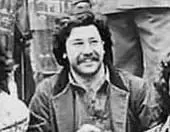
Francesco Lorusso, 26 years old, university student
It’s a very long hug: thirty years and six days. It is a ‘gesture of pacification’ between two former fifty-year-old boys, divided by a pain, finally brought together by the same pain. It is a human squeeze at the beginning uncertain, then strong, that melts in a few moments the frost of the decades. ‘It’s an encounter between men,’ says Giovanni when the words manage to go back to his lips, ‘nothing more, nothing less.’ Almost peers, almost work colleagues, both married, both with children who are more or less the last age that Francesco had, both engaged in two different spiritual itineraries: two parallel and specular lives. ‘It’s the moment I’ve been imagining for years,’ Massimo searches for the words. There is one, of words, floating in the air, waiting to be summoned. That word is ‘forgave’, but both realize, almost surprised, that they don’t need it. ‘Forgiveness is only from God,’ says Giovanni, ‘and then if I now said ‘I forgive you’, it would mean that so far I thought you were guilty. Instead, this is not the case. That day Francesco’s life was turned upside down, but so was yours. You weren’t the real culprit.’ Tramontani nods, he understands well the meaning of these words. There is a historical sense, because Tramontani certainly remembers having shot, but he never had the certainty that in that thick smoke he was the one who hit, or if it was instead someone else who that day next to him perhaps shot, who can say it, no one can say it, Tramontani himself says he does not know, however no judge was put in a position to decide it, for that poisoned gift of the acquittal for ‘legitimate use of weapons’. But that is not what is being talked about today in the silence of the convent. In reality, when Lorusso says ‘you are not the real culprit’ he does not think about the judicial truths, he thinks above all of the harsh morals of history, of the responsibilities of those who had the power to assume them. Think of who then put two boys against each other, two who did not know each other and did not hate each other, and left, or wanted, or took into account that one would kill the other; and there were also those who, later, damaged Francis’ memory to save his own. Giovanni thinks about it for a few more moments, and concludes: ‘Ours is a meeting between two victims.’ ‘Two victims of the state,’ Father Benito completes. To the century Benito Fusco, for the companions of the time Benito the Red, militant of Lotta continua, today friar of the order of the Servants of Mary.
On March 11, 1977 in Bologna, the agent Tramontani shot and the student Francesco Lorusso died. Why? How?
The sequence of events that led to the killing of Lorusso took place in the network of streets delimited by Via Irnerio, Via Zamboni and Via Mascarella, an important part of the city’s university area. At 10 a.m. on Friday, March 11, a few hundred students and professors close to the Catholic Communion and Liberation (CL) movement gathered to discuss the university’s crisis and the issues of the youth condition in a classroom of the University Institute of Anatomy in Via Irnerio. The usability of the spaces and the right to speak were often the subject of dispute during the occupations of the faculties, the members of CL who intervened in the past in student assemblies were often silenced or expelled by young people of the extreme left. Some CL students thus set up an order service to protect their meeting. According to some versions, a small group of far-left young people attempted to enter the courtroom and were rejected; others recounted that some protesters, after being expelled from the courtroom, called for reinforcements. The news of the fight, in any case, reached the ears of students and extra-parliamentarians of the movement who from Via Zamboni and Piazza Verdi reached the Institute of Anatomy in large numbers. Occupied the outside courtyard, they besieged the building, throwing insults and threats to the CL students who barricaded themselves in the classroom, called the police and also had the rector Carlo Rizzoli warned by telephone. The latter sent alarming news to the quaestor Gennaro Palma who, in agreement with the prefect, decided to send a contingent composed of carabinieri and a department of the celere to via Irnerio. Officials of the political office of the police station who arrived quickly on the spot started a dialogue with the young people of the movement, the goal was to calm the moods, drive the besiegers away towards Porta Zamboni and thus allow the outflow of CL students in the opposite direction. During the negotiations the police column arrived, the men of the celere were waiting on the vehicles, a group of agents, on the other hand, approached the courtyard on foot to form a cordon of security. Some students began to leave the Anatomy room, but just as the tension seemed on the verge of melting, violent rabbles broke out: the agents of the celere threw a sudden charge hitting with their batons the young people of the movement who were still stationed near the courtyard, students and militants of the extreme left responded by throwing pebbles as they folded back towards Porta Zamboni, others armed with sticks went to the clash. Law enforcement definitively cleared the area by firing dozens of teardrop candles in all directions. Between scenes of panic and in the general excitement, all the CL students managed to move away, heading quickly towards Piazza VIII August. In the meantime, some young people of the movement were preparing for the counterattack in the university buildings occupied between Piazza Verdi and Via Zamboni. They supplied themselves with Molotov bottles, prepared and hidden in the previous days in view of a demonstration called for March 12 in Rome. A group took Via Bertoloni and arrived at the intersection with Via Irnerio invaded by smoke, threw incendiary stones and bottles at men and vehicles of carabinieri and police, then immediately retreated chased by the throwing of other tear gas.
Massimo Tramontani, a young military carabiniere, had arrived in the area driving an Arma truck and was waiting for orders from the superiors next to the vehicle parked near the intersection between via Irnerio and via Centotrecento, a road parallel to via Bertoloni. After dodging some stones thrown by extra-parliamentarians, he decided to react by firing his rifle. Years later, Tramontani reconstructed those moments like this: “They are masked and throw porphyry cubes, me and two policeman jump to dodge them, then they try to throw a tear gas but it falls four meters in front, the students encouraged by this fool advance and continue to throw. There are many, I’m alone, where is the captain? I wonder, I decide to react, I shoot in the air with the winchester. I repeat: in the air […], I just want to scare, in fact they run away” [5]. No one was injured, the bullets went empty, but according to Raffaele Bertoncelli, a former Lotta continua present in the group that attacked from Via Bertoloni, ‘while we were running away, the carabinieri shoot us rifle shots at man’s height’ [6]. The molotov cocktails damaged two cars, one of which was supplied to the police. The contingent of the police, believing the situation near the Institute of Anatomy resolved, began to retreat along via Irnerio in the direction of Piazza VIII August, where the crowded weekly market of Bologna, the “Piazzola”, was underway. While the movement of the vehicles proceeded slowly, policemen and carabinieri who followed on foot noticed the movements of numerous young people in via Centotrecento and, fearing a new attack, dispersed them by throwing other tear gas. The second raid against the police, however, materialized soon after in the parallel road, via Mascarella, taking by surprise the autocolumn of the agents, which was left without a large part of the escort at the back.
Francesco Lorusso was in the group of students and extra-parliamentarians who, with porphyry cubes and incendiary bottles, ran to the intersection with Via Irnerio. After a morning spent studying at a friend’s house, he had reached the university area and here, knowing of the charges and clashes in front of the Institute of Anatomy, he had joined the fellow militants who intended to react. At the end of the portico of via Mascarella, some threw stones towards police cars and trucks; Lorusso and his friend Beppe Ramina, on the other hand, threw two Molotov cocktails: the first crashed in the middle of the roadway, the other hit the door of the truck led by Massimo Tramontani, causing a beginning of fire at the height of the driver’s cab. After the blitz, Lorusso and the other extra-parliamentarians fled under the portics of via Mascarella with the intention of reaching via Belle Arti. While some agents and a journalist were working to tame the flames on his vehicle, Tramontani came down from the driver’s seat, took himself to the center of via Irnerio and opened fire with his 9-caliber Beretta pistol in the direction of the portics of via Mascarella: “I go down with the gun and fire at the demonstrators. But without the intention to kill. […] I don’t want to kill, I mean, I want to scare them more, since shooting in the air is not useful. I shoot where I see that there is no one, towards the walls,” he declared to ‘Repubblica’ in 1997.
He exploded six shots, it was the second time he fired that morning. Lorussus was reached by a bullet that pierced him transversely, penetrating the left anterior region of the chest to come out of the back, at the back of the right hemithorax. Probably, as he fled, he had turned to look at what was happening behind him: he managed to take a few more steps in the opposite direction, so he fell at number 37 of via Mascarella and died in a few moments. The other non-parliamentarians stopped their escape and approached in a vain attempt to help him. Some dragged the body to Via Belle Arti and asked for help from shopkeepers and a passing motorist to arrange transport to the emergency room. Policemen, carabinieri and Tramontani himself were not concerned with verifying the consequences of the shootings and, ignoring what had happened, resumed the march towards Piazza VIII August, definitively moving away from the places of the clashes. After minutes of excitedness, an ambulance entered the wrong direction in via Mascarella from via Irnerio, Lorusso’s body was loaded on board and taken to the Sant’Orsola hospital, but the doctors only had to certify the death of the young man. The news spread quickly: Radio Alice, a broadcaster close to the Bolognese movement, gave it already at 1.30 p.m. Piazza Verdi and the surrounding streets, in the heart of the university area, were quickly filled with militants of the extra-parliamentary left and friends of Lorusso, united by anger and exasperation. The young people attributed the political responsibility for the killing of Lorusso to Christian Democracy, the largest party in the government area, and to its exponent Francesco Cossiga, Minister of the Interior. So, around 5 p.m., a procession composed of thousands of young people from the movement went up via Zamboni to cross the center of Bologna and reach the provincial headquarters of Christian Democracy in via San Gervasio, where militants and members of the order services intended to carry out the assault with molotov cocktails, stones and spans. Some had firearms with them. During the journey it was touched by the physical clash with militants of the Communist Party placed in the garrison of the Sacred of Fallen Partisans and the municipal headquarters of Palazzo D’Accursio, windows and cars were destroyed, until the impact with the contingent of the police in front of the headquarters of the Dc. The crowd of young people, hardly rejected, split into various sections and heated hotbeds of urban guerrillas in various parts of the city, opposed by tear gas throws. At the train station there was a prolonged firefight with police officers. Finally, in the evening, students and extra-parliamentaries gathered in the university area after raising barricades.
The next morning a unified trade union demonstration was held in Piazza Maggiore, protected by a large order service composed of members of the Pci. Hundreds of young people arrived in a procession from the university area and, in a climate of strong tension, negotiations began to get representatives of the movement to speak from the stage. The agreement was not found: the organizers demanded a condemnation of the violence and damage of the day before, the extra-parliamentarians rejected the conditions claiming the legitimacy of their reaction. The demonstration, thus, closed without the intervention of people close to Lorusso, a new rift between the Pci and the movement.
In the afternoon the police repeatedly tried to clear Piazza Verdi and Via Zamboni, but they were always rejected by the occupants and again they shot themselves on both sides. Police and carabinieri managed to take control of the area at dawn on Sunday, March 13, entering with armored vehicles in the streets abandoned hours before by extra-parliamentarians. One dead, numerous wounded and part of the city center devastated by fires and damage: with this balance a dramatic page for Bologna closed.
At the end of a long trial, the Court of Appeal declared the nullity of Catalanotti’s investigation and ordered the immediate release of Tramontani. The latter, for the Court, was the only one to shoot at Lorusso, but he made legitimate use of weapons and for this reason criminal prosecution could not be promoted against him. Pistolese was acquitted for not committing the fact.
