
Franco Bigonzetti, Francesco Ciavatta e Stefano Recchioni sono i tre ragazzi uccisi il 7 Gennaio 1978 in quella che è nota come “Strage di Acca Larenzia”.
I due giovani Franco Bigonzetti e Francesco Ciavatta, entrambi tra i 18 e i 19 anni, si trovavano di fronte alla sezione del Movimento Sociale Italiano di Via Acca Larenzia quando vennero uccisi in un agguato di natura terroristica che venne rivendicato dai Nuclei Armati per il Contropotere Territoriale. Nelle ore successive, una folla di militanti dell’MSI si riunì di fronte alla sezione, e proprio in questo contesto si crearono alcune tensioni con le forze dell’ordine: furono esplosi alcuni colpi d’arma da fuoco, uno dei quali colpì il 20enne Stefano Recchioni, anche lui giovane militante missino, uccidendolo. Pur trattandosi di un episodio separato, la morte di Recchioni è generalmente inserita nella memoria collettiva come parte della Strage di Acca Larenzia.
La dinamica
Verso le 18:20 cinque giovani militanti missini, che si apprestavano a uscire dalla sede del Movimento Sociale Italiano in via Acca Larenzia per pubblicizzare con un volantinaggio un concerto del gruppo di musica alternativa di destra Amici del Vento, furono investiti dai colpi di diverse armi automatiche sparati da un gruppo di fuoco formato da cinque o sei persone. Uno dei militanti, Franco Bigonzetti, ventenne iscritto al primo anno della facoltà di medicina e chirurgia, rimase ucciso sul colpo.
Il meccanico Vincenzo Segneri, ferito a un braccio, rientrò nella sede del partito e, assieme agli altri due militanti rimasti illesi – Maurizio Lupini, responsabile dei comitati di quartiere, e lo studente Giuseppe D’Audino – riuscì a chiudere dietro di sé la porta blindata, sfuggendo in questo modo all’agguato. Lo studente diciottenne Francesco Ciavatta, pur ferito, tentò di fuggire lungo la scalinata situata a lato dell’ingresso della sezione ma, inseguito dagli aggressori, fu colpito nuovamente alla schiena; morì in ambulanza durante il trasporto in ospedale.
Nelle ore seguenti, col diffondersi della notizia dell’agguato tra i militanti missini, una folla sgomenta di attivisti organizzò un sit-in di protesta sul luogo della tragedia. Qui, forse per il gesto distratto di un giornalista che avrebbe gettato un mozzicone di sigaretta nel sangue rappreso sul terreno di una delle vittime, nacquero tafferugli e scontri che, fra l’altro, danneggiarono le apparecchiature video dei giornalisti Rai e provocarono l’intervento delle forze dell’ordine, con cariche e lancio di lacrimogeni. Uno di questi colpì anche l’allora segretario nazionale del Fronte della Gioventù, Gianfranco Fini.
Secondo alcune testimonianze, smentite molti anni dopo da perizie balistiche, i Carabinieri spararono alcuni colpi in aria mentre il capitano Eduardo Sivori sparò mirando ad altezza d’uomo, ma la sua arma s’inceppò; l’ufficiale si fece quindi consegnare la pistola dal suo attendente e sparò di nuovo, questa volta centrando in piena fronte il diciannovenne Stefano Recchioni, militante della sezione di Colle Oppio e chitarrista del gruppo di musica alternativa Janus. Questa versione si rivelò completamente priva di fondamento tanto che diversi anni dopo l’ufficiale fu assolto per non aver commesso il fatto. Il giovane sarebbe morto dopo due giorni di agonia.
Le indagini non hanno mai individuato in maniera chiara i colpevoli dell’attentato rivendicato dai Nuclei Armati per il Contropotere territoriale. L’arma del delitto, una mitragliatrice Scorpion, venne trovata nel 1988 in un covo delle Brigate Rosse a Milano, e si scoprì che tra il 1985 e il 1988 la stessa arma era stata usata contro l’economista Ezio Tarantelli, l’ex sindaco di Firenze Lando Conti e il senatore della Democrazia Cristiana Roberto Ruffilli, tutti e tre uccisi dalle BR.
Fonti
Wikipedia
Strage di Acca Larenzia – Wikipedia
Rerumromanarum.com
Rerum Romanarum: Targa in memoria delle vittime della Strage di Acca Larenzia
Approfondimenti
Il Tempo
Spazio70
Video
AAMOD
https://www.youtube.com/watch?v=41fcGC_-VEc
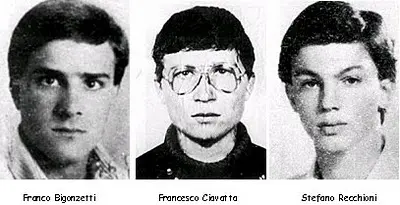
da Oggi nella Storia
English version
Franco Bigonzetti, 19 years old, university student
Francesco Ciavatta, 18 years old, high school student
Stefano Recchioni, 19 years old, student
Franco Bigonzetti, Francesco Ciavatta and Stefano Recchioni are the three boys killed on January 7, 1978 in what is known as the ‘Strage di Acca Larenzia’.
The two young people Franco Bigonzetti and Francesco Ciavatta, both between 18 and 19 years old, were in front of the section of the Italian Social Movement in Via Acca Larenzia when they were killed in an ambish of a terrorist nature that was claimed by the Armed Nuclei for the Territorial Counterpower. In the following hours, a crowd of MSI militants gathered in front of the section, and precisely in this context some tensions were created with the police: some gunshots were fired, one of which hit the 20-year-old Stefano Recchioni, also a young Missino militant, killing him. Although it is a separate episode, the death of Recchioni is generally inserted in the collective memory as part of the Massacre of Acca Larenzia.
The dynamic:
Around 18:20 five young Missini militants, who were preparing to leave the headquarters of the Italian Social Movement in via Acca Larenzia to advertise with a flyer a concert of the right-wing alternative music group Amici del Vento, were hit by the shots of several automatic weapons fired by a firegroup of five or six people. One of the militants, Franco Bigonzetti, in his twenties, enrolled in the first year of the faculty of medicine and surgery, was killed on the spot.
The mechanic Vincenzo Segneri, wounded in the arm, returned to the party’s headquarters and, together with the other two unharmed militants – Maurizio Lupini, head of the neighborhood committees, and the student Giuseppe D’Audino – managed to close the armored door behind him, thus escaping the ambed. The eighteen-year-old student Francesco Ciavatta, although wounded, tried to escape along the staircase located next to the entrance of the section but, chased by the aggressors, was hit again in the back; he died in an ambulance while transporting to the hospital.
In the following hours, as the news spread of the ambow among the Missini militants, a dismayed crowd of activists organized a protest sit-in at the scene of the tragedy. Here, perhaps because of the distracted gesture of a journalist who allegedly threw a cigarette butt into the blood raptured on the ground of one of the victims, clashes and clashes were born that, among other things, damaged the video equipment of the Rai journalists and provoked the intervention of the police, with charges and throwing of tear gas. One of these also hit the then national secretary of the Youth Front, Gianfranco Fini.
According to some testimonies, denied many years later by ballistic expert reports, the Carabinieri fired some shots into the air while Captain Eduardo Sivori fired aiming at the height of a man, but his weapon jammed; the officer then had his gun delivered to his attendant and fired again, this time hitting in full forehead the nineteen-year-old Stefano Recchioni, a militant of the Colle Oppio section and guitarist of the alternative music group Janus. This version turned out to be completely unfounded so much so that several years later the officer was acquitted for not committing the fact. The young man would have died after two days of agony.
The investigations have never clearly identified the culprits of the attack claimed by the Armed Nuclei for the Territorial Counterpower. The weapon of the crime, a Scorpion machine gun, was found in 1988 in a den of the Red Brigades in Milan, and it was discovered that between 1985 and 1988 the same weapon had been used against the economist Ezio Tarantelli, the former mayor of Florence Lando Conti and the senator of the Christian Democracy Roberto Ruffilli, all three killed by the BR.
