
Giovedì 16 marzo 1978, a Roma, era previsto il dibattito alla Camera dei deputati e il voto di fiducia per il quarto Governo presieduto da Giulio Andreotti: si trattava di un momento di grande importanza poiché, per la prima volta dal 1947, il PCI avrebbe concorso direttamente alla maggioranza parlamentare che avrebbe sostenuto il nuovo esecutivo. Principale artefice di questa complessa e difficoltosa manovra politica era stato Aldo Moro, presidente della Democrazia Cristiana.
Con un faticoso lavoro di mediazione e sintesi politica, Moro, che aveva intrapreso approfonditi colloqui con il segretario comunista Enrico Berlinguer, era riuscito a sviluppare il rapporto politico tra i due maggiori partiti italiani usciti dalle elezioni del 1976, la Democrazia Cristiana e il Partito Comunista Italiano. Aldo Moro aveva dovuto superare forti resistenze interne al suo partito e contrasti tra le varie forze politiche: fino alle ultime ore erano sorti nuovi problemi legati alla composizione ministeriale, giudicata insoddisfacente dai comunisti, del nuovo Governo guidato da Giulio Andreotti.
Il 28 febbraio, durante le consultazioni a Montecitorio, Moro espose ai gruppi parlamentari democristiani la sua analisi della situazione, e la sua prognosi. Fu il suo ultimo discorso pubblico. Moro riconobbe che da anni qualcosa s’era guastato nel normale meccanismo della democrazia italiana poiché, dopo le elezioni di due anni prima, erano emersi due vincitori; perciò bisognava approfittare della disponibilità del PCI a «trovare un’area di concordia, un’area di intesa tale da consentire di gestire il Paese finché durano le condizioni difficili alle quali la storia di questi anni ci ha portato».
L’11 marzo Andreotti si recò al Quirinale con la lista dei ministri: in precedenza Berlinguer aveva chiesto che fossero depennati dall’elenco i ministri considerati più anticomunisti e che fosse designato qualche tecnico. All’interno del PCI ci fu chi vide in quell’esecutivo monocolore una provocazione. Giancarlo Pajetta annunciò che non avrebbe partecipato alle votazioni. Tra i pareri di chi voleva si rifiutasse il Governo, e chi voleva lo si accettasse, ne prevalse un terzo: i comunisti avrebbero risolto il dilemma dopo aver ascoltato il discorso di Andreotti alla Camera.
Aldo Moro era inoltre obiettivo, oltre che di attacchi politici, di manovre scandalistiche che miravano a minarne l’autorevolezza. Nel quadro delle indagini sul cosiddetto scandalo Lockheed, era stato ventilato sulla stampa che il famoso «Antelope Cobbler», il misterioso referente politico principale coinvolto nella transazione finanziaria con l’industria aeronautica statunitense, sarebbe potuto essere proprio Moro. Il mattino del 16 marzo 1978 il quotidiano la Repubblica pubblicava in terza pagina un articolo in questo senso con il titolo: Antelope Cobbler? Semplicissimo, è Aldo Moro, altri importanti quotidiani nazionali riportavano le stesse notizie.
La presentazione delle dichiarazioni programmatiche del nuovo governo Andreotti alla Camera dei deputati era stata fissata per le 10:00 del 16 marzo e fin dalle 8:45 gli uomini della scorta di Aldo Moro erano in attesa, fuori dalla sua casa in via del Forte Trionfale 79, che l’uomo politico uscisse dalla propria abitazione per accompagnarlo in Parlamento. Aldo Moro scese qualche minuto prima delle 9:00] e venne accompagnato dal maresciallo dei carabinieri Oreste Leonardi, suo fedele collaboratore da molti anni, all’auto di rappresentanza, una Fiat 130 berlina non blindata, dove si sedette sui sedili posteriori. Subito dopo il piccolo convoglio, l’auto del presidente e quella della scorta, si mise in movimento in direzione di via della Camilluccia. Le auto procedevano a velocità abbastanza sostenuta, mentre l’uomo politico consultava il pacco dei giornali del mattino: prima di raggiungere la Camera dei deputati era prevista l’abituale sosta nella Chiesa di Santa Chiara.
Alle ore 9:00 circa in via Mario Fani, quartiere Trionfale, l’auto con a bordo Aldo Moro e quella della scorta furono bloccate all’incrocio con via Stresa da un gruppo di terroristi che aprirono immediatamente il fuoco, uccisero in pochi secondi i cinque uomini della scorta e sequestrarono Moro. I terroristi ripartirono subito su diverse auto e fecero perdere le loro tracce. In via Fani rimasero la Fiat 130, targata «Roma L59812» su cui viaggiava Moro, con i cadaveri dell’autista, appuntato dei carabinieri Domenico Ricci (43 anni) e del responsabile della sicurezza, maresciallo dei carabinieri Oreste Leonardi (51 anni), e l’Alfa Romeo Alfetta targata «Roma S93393» degli agenti di scorta con a bordo il cadavere della guardia di P.S. Giulio Rivera (23 anni) e il vicebrigadiere di Pubblica sicurezza Francesco Zizzi (29 anni) gravemente ferito ma ancora in vita; riverso supino sul piano stradale, vicino all’auto, rimase anche il corpo della guardia di P.S. Raffaele Iozzino, 24 anni. Davanti alla Fiat 130 rimase un’auto Fiat 128 familiare con targa del corpo diplomatico «CD 19707», ferma all’incrocio e abbandonata dai suoi occupanti.
La prima comunicazione alle forze dell’ordine dei fatti accaduti venne registrata alle 9:03 al 113 che ricevette una telefonata anonima che informava di una sparatoria avvenuta in via Mario Fani; la centrale operativa del 113 provvide quindi ad allertare subito la pattuglia del Commissariato di Monte Mario che era in sosta in via Bitossi. Gli agenti vennero avvertiti che «si sono uditi diversi colpi di arma da fuoco» in via Fani. Dalla documentazione della Questura risulta che già alle 9:05 arrivò la prima comunicazione degli agenti della pattuglia di Monte Mario che, giunti sul posto in via Fani, provvidero ad allontanare la folla che si era radunata, ispezionarono le auto con i colleghi morenti, raccolsero le prime notizie dalle persone presenti e richiesero di «inviare subito le autoambulanze, sono della scorta di Moro e hanno sequestrato l’onorevole» (Sergio Flamigni ritiene errata l’indicazione dell’ora presente nella documentazione della Questura: a suo parere sarebbe stato impossibile per gli agenti dell’autopattuglia in appena due minuti raggiungere via Fani ed espletare il primo sopralluogo. Egli ritiene che l’orario del rapporto nella fretta del momento non venne indicato nell’annotazione e probabilmente venne aggiunto in un secondo momento). Gli agenti riferirono anche che i malviventi si sarebbero allontanati su una Fiat 128 bianca con targa «Roma M53995»; i poliziotti della pattuglia diramarono anche l’informazione che i terroristi sarebbero stati quattro e avrebbero indossato «divise da marinai o da poliziotti».
Nel frattempo, dopo una seconda telefonata anonima, erano state messe in allarme e inviate in via Fani anche le volanti Beta 4, Zara, V12 e SM91: furono informati delle prime notizie la Questura, la Criminalpol, la Squadra mobile, la DIGOS e il Commissariato di Monte Mario. Nei minuti successivi, entro le ore 9:10, venne comunicato alle autoradio delle volanti dalla sala operativa della Questura di ricercare, oltre alla Fiat 128 bianca in cui erano stati segnalati quattro giovani a bordo, anche una auto Fiat 132 blu targata «Roma P79560» e una «moto Honda scura». Alle 9:15 la Questura comunicò la notizia dell’agguato di via Fani alla centrale operativa della Legione dei carabinieri di Roma. Alla stessa ora la centrale operativa registrò anche la comunicazione telefonica di Pino Rauti che, abitando in via Fani, ebbe modo di osservare da una finestra alcune fasi dell’agguato e comunicò subito di aver sentito raffiche di mitra, di aver visto due uomini vestiti da ufficiali dell’aeronautica e di aver osservato allontanarsi una Fiat 132 blu.
(…)
Il numero reale dei componenti del gruppo brigatista in via Fani, la loro identità e la loro dislocazione sul luogo dell’azione sono stati fin dall’inizio elementi fortemente discussi e fonti di grandi diatribe e valutazioni ampiamente discordanti in sede processuale, pubblicistica e storica. I brigatisti, collaboranti o comunque interessati a descrivere i fatti di via Fani, hanno fornito nel corso del tempo informazioni spesso contraddittorie, non del tutto attendibili, e hanno mostrato una notevole reticenza riguardo a questo argomento decisivo.
Inizialmente nessun brigatista direttamente partecipante agli eventi di via Fani collaborò con gli inquirenti e quindi il primo processo sui fatti del sequestro Moro, celebrato tra il 1982 e il 1983, dovette basarsi su elementi indiziari e sulle testimonianze di alcuni collaboratori di giustizia, tra cui Patrizio Peci, che non essendo stati coinvolti attivamente, riferirono solo informazioni apprese in via indiretta. Il primo processo condannò dieci terroristi come responsabili materiali dell’agguato: Lauro Azzolini, Barbara Balzerani, Franco Bonisoli, Adriana Faranda, Raffaele Fiore, Prospero Gallinari, Mario Moretti, Valerio Morucci, Luca Nicolotti e Bruno Seghetti. Fu Valerio Morucci che, a partire dalla sua testimonianza resa davanti alla Commissione parlamentare d’inchiesta del 1983, iniziò a raccontare dettagliatamente i particolari dell’agguato, pur rifiutandosi inizialmente di fornire i nomi dei partecipanti. In un primo momento disse che i terroristi coinvolti erano stati «poco più di dodici», quindi durante il processo d’appello del 1985 ridusse il numero a nove partecipanti (cifra successivamente confermata da Bonisoli). In quella sede ricostruì le fasi dell’agguato: escluse che Lauro Azzolini, Luca Nicolotti e Adriana Faranda avessero fatto parte del gruppo di via Fani e implicitamente invece confermò che gli altri condannati in primo grado avevano effettivamente concorso al fatto criminale. Le sue affermazioni furono ritenute attendibili dalla Corte d’appello di Roma.
Nel corso degli anni i brigatisti confermarono la presenza di Moretti, Bonisoli, Gallinari, Balzerani, Fiore, Morucci e Seghetti e diedero una loro parziale ricostruzione dei fatti e del ruolo dei principali partecipanti in via Fani. Inoltre Morucci, nel terzo processo sul caso Moro, rivelò indirettamente che anche Alessio Casimirri e Alvaro Lojacono erano stati parte del gruppo con il ruolo di copertura posteriore lungo via Fani.
Nel 1994 Mario Moretti, nel suo libro di memorie, descrisse la presenza di un decimo componente, una donna – identificata in un secondo tempo in Rita Algranati – che avrebbe avvistato per prima le auto del politico democristiano e segnalato l’arrivo del convoglio: infine comparve anche il nome di Raimondo Etro, di cui venne ritenuta probabile la presenza nella zona il 16 marzo con il compito di raccogliere dopo l’agguato le armi utilizzate dal gruppo di fuoco. Tuttavia, sulla base delle risultanze processuali e delle inchieste delle commissioni parlamentari, le versioni dei brigatisti, modificate numerose volte durante gli anni, non sono state ritenute del tutto esaurienti: in questa sede, e anche a livello pubblicistico, si è continuato a ritenere che il numero dei partecipanti in via Fani sia stato più alto.
In particolare, oltre a ipotizzare la presenza di altre persone all’incrocio di via Stresa in appoggio della Balzerani e di un’altra persona già a bordo della Fiat 128 blu su cui sarebbero fuggiti Morucci, Balzerani e Bonisoli, è stato ritenuto soprattutto altamente probabile che altri due terroristi fossero presenti a bordo di una moto Honda, come riferito fin dall’inizio da almeno tre testimoni (tra cui l’ingegnere Alessandro Marini che, a bordo di un motorino all’incrocio di via Fani con via Stresa, avrebbe visto i due sulla moto, ricevendo anche dei colpi di mitra che colpirono il suo parabrezza). Anche l’agente della polizia stradale non in servizio Giovanni Intrevado che, con la sua Fiat 500, venne bloccato all’incrocio di via Stresa da una donna armata di mitra senza poter intervenire, riferì di aver visto una moto di «grossa cilindrata» con due uomini a bordo. La presenza di altri militanti su una moto Honda è invece sempre stata smentita dai brigatisti. Raimondo Etro ha smentito di essere stato uno dei passeggeri della Honda ed ha affermato che Alessio Casimirri lo aveva informato della presenza imprevista di una moto che non aveva nulla a che fare con il commando brigatista.
Inoltre dal racconto di alcuni testimoni, tra cui lo stesso ingegner Marini, e dalle risultanze delle perizie sui cadaveri, in sede processuale si sono raggiunte conclusioni parzialmente discordanti rispetto alla versione dei brigatisti sulla esatta modalità dell’agguato: queste ricostruzioni prevederebbero la presenza di un altro uomo a bordo della Fiat 128 CD accanto a Moretti. Sarebbe stato quest’uomo, secondo la perizia del processo del 1993, che sarebbe sceso dal lato destro della Fiat 128 CD e avrebbe aperto il fuoco dalla destra della strada colpendo subito mortalmente il maresciallo Leonardi. Questa ricostruzione permetterebbe di spiegare le direzioni dei colpi rilevate dalle perizie sui corpi del maresciallo Leonardi, 9 colpi rinvenuti con orientamento da destra a sinistra, dell’agente Rivera, 5 colpi da destra a sinistra, e forse dell’agente Iozzino e del vicebrigadiere Zizzi, su cui le perizie sono più incerte. Sull’identità di questo ipotetico brigatista in azione sul lato destro della strada non si è giunti a conclusioni realmente attendibili, anche se lo scrittore Manlio Castronuovo ritiene che fosse Riccardo Dura, brigatista genovese particolarmente determinato, morto nel 1980 nello scontro di via Fracchia a Genova.
I brigatisti hanno sempre escluso la presenza di loro militanti sul lato destro della strada e hanno evidenziato che essi aprirono il fuoco solo dalla sinistra per evitare gravi rischi di incidenti fortuiti con la possibilità di colpirsi tra loro per errore. In effetti deve essere rilevato che la maggior parte dei testimoni oculari riferirono soltanto di aver visto un numero variabile di «avieri» sparare dal lato sinistro della strada contro le auto ferme. Riguardo alla eventuale presenza di Riccardo Dura in via Fani, Valerio Morucci la escluse decisamente in sede processuale rivelando che il brigatista genovese effettivamente era stato in un primo tempo compreso nel gruppo con il ruolo di aiutare Barbara Balzerani all’incrocio di via Stresa, ed era anche giunto a Roma dove abitava nell’appartamento di quest’ultima, ma alcuni giorni prima dell’agguato si decise di rinunciare alla sua partecipazione.
Fonte
Wikipedia
https://it.wikipedia.org/wiki/Agguato_di_via_Fani
Approfondimenti
Ugo Maria Tassinari – Intervista a Mario Moretti
https://www.ugomariatassinari.it/sequestro-moro-1/
https://www.ugomariatassinari.it/via-fani/
Video
Atlantide/La7
Caso Moro, l’attentato di Via Fani raccontato da Andrea Purgatori
Polizia di Stato
Archivio Luce Cinecittà
https://www.youtube.com/watch?v=M9ya8Dn0VO8
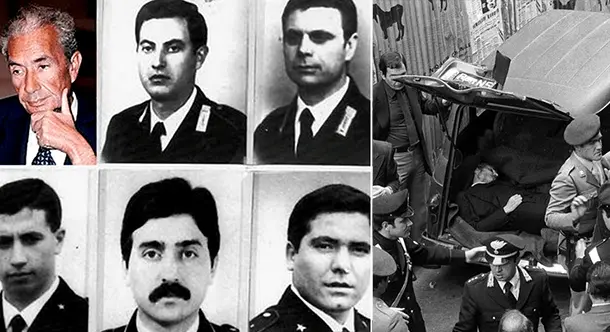
da Antimafia 2000
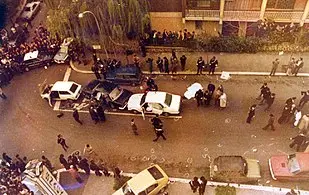
da Wikipedia
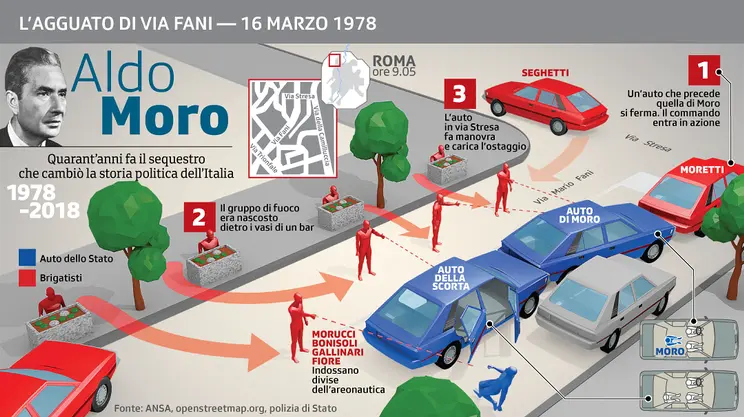
da Ugo Maria Tassinari
English version
Oreste Leonardi, 51 years old, Major Marshal Assistant to the Carabinieri
Domenico Ricci, 43 years old, pinned by the Carabinieri
Giulio Rivera, 23, Public Security Guard
Francesco Zizzi, 29, deputy brigadier of Public Security
Raffaele Iozzino, 25 years old, Public Security Guard
On Thursday, March 16, 1978, in Rome, the debate was scheduled in the Chamber of Deputies and the vote of confidence for the fourth Government chaired by Giulio Andreotti: it was a moment of great importance since, for the first time since 1947, the PCI would contribute directly to the parliamentary majority that would support the new executive. The main architect of this complex and difficult political maneuver had been Aldo Moro, president of the Christian Democracy.
With a strenuous work of mediation and political synthesis, Moro, who had undertaken in-depth talks with communist secretary Enrico Berlinguer, had managed to develop the political relationship between the two major Italian parties that emerged from the 1976 elections, the Christian Democracy and the Italian Communist Party. Aldo Moro had had to overcome strong internal resistance to his party and contrasts between the various political forces: until the last few hours new problems had arisen related to the ministerial composition, judged unsatisfactory by the communists, of the new government led by Giulio Andreotti.
On February 28, during the consultations in Montecitorio, Moro sposed to the Christian Democratic parliamentary groups his analysis of the situation, and his prognosis. It was his last public speech. Moro recognized that for years something had failed in the normal mechanism of Italian democracy because, after the elections two years earlier, two winners had emerged; therefore it was necessary to take advantage of the willingness of the PCI to ‘find an area of harmony, an area of understanding that allows us to manage the country as long as the difficult conditions to which the history of these years has brought us last’.
On March 11, Andreotti went to the Quirinale with the list of ministers: previously Berlinguer had asked that the ministers considered the most anti-communist be removed from the list and that some technicians be appointed. Within the PCI there were those who saw in that monochrome executive a provocation. Giancarlo Pajetta announced that he would not participate in the votes. Among the opinions of those who wanted to refuse the government, and those who wanted to accept it, a third prevailed: the communists would have solved the dilemma after listening to Andreotti’s speech in the Chamber.
Aldo Moro was also the target, in addition to political attacks, of scandalous maneuvers aimed at undermining its authority. As part of the investigation into the so-called Lockheed scandal, it was told in the press that the famous ‘Antelope Cobbler’, the mysterious main political referent involved in the financial transaction with the US aviation industry, could have been Moro. On the morning of March 16, 1978, the newspaper la Repubblica published on the third page an article in this regard with the title: Antelope Cobbler? Very simple, it is Aldo Moro, other important national newspapers reported the same news.
The presentation of the programmatic statements of the new Andreotti government to the Chamber of Deputies had been set for 10:00 on March 16 and from 8:45 the men of Aldo Moro’s escort were waiting, outside his house in via del Forte Trionfale 79, for the politician to leave his home to accompany him to Parliament. Aldo Moro got off a few minutes before 9:00] and was accompanied by the carabinieri marshal Oreste Leonardi, his faithful collaborator for many years, to the representative car, a Fiat 130 unarmored sedan, where he sat in the rear seats. Immediately after the small convoy, the president’s car and that of the escort, he set in motion in the direction of Via della Camilluccia. The cars were proceeding at a fairly fast speed, while the politician consulted the morning newspaper package: before reaching the Chamber of Deputies, the usual stop in the Church of Santa Chiara was scheduled.
At about 9:00 am in via Mario Fani, Trionfale district, the car with Aldo Moro on board and that of the escort were blocked at the intersection with Via Stresa by a group of terrorists who immediately opened fire, killed the five men of the escort in a few seconds and kidnapped Moro. The terrorists immediately restarted in several cars and lost their tracks. In via Fani there remained the Fiat 130, with the ‘Roma L59812’ on which Moro was traveling, with the corpses of the driver, pinned by the carabinieri Domenico Ricci (43 years old) and the head of security, marshal of the carabinieri Oreste Leonardi (51 years old), and the Alfa Romeo Alfetta with the ‘Roma S9339393’ of the escort agents with the corpse of the guard on board. Giulio Rivera (23 years old) and the deputy brigadier of Public Security Francesco Zizzi (29 years old) seriously injured but still alive; supino riverso on the road level, near the car, also remained the body of the P.S. guard. Raffaele Iozzino, 24 years old. In front of the Fiat 130 remained a family Fiat 128 car with a license plate of the diplomatic corps ‘CD 19707’, stopped at the intersection and abandoned by its occupants.
The first communication to the police of the events that happened was recorded at 9:03 at 113 which received an anonymous phone call informing of a shooting that took place in via Mario Fani; the operational center of 113 then immediately alerted the patrol of the Commissariat of Monte Mario that was parked in via Bitossi. Officers were warned that ‘several gunshots were heard’ in Via Fani. From the documentation of the Police Headquarters it appears that already at 9:05 the first communication of the agents of the patrol of Monte Mario arrived who, arrived on the spot in via Fani, provided for the removal of the crowd that had gathered, inspected the cars with the dying colleagues, collected the first news from the people present and requested to “send the ambulances immediately, they are of the escort of Moro and have seized the honorable” (Sergio Flamigni considers the indication of the time present in the documentation of the Police Headquarters to be incorrect: in his opinion it would have been impossible for the agents of the patrol car in just two minutes to reach via Fani and carry out the first inspection. He believes that the time of the report in the rush of the moment was not indicated in the annotation and was probably added at a later date). The officers also reported that the thuts would move away on a white Fiat 128 with a license plate ‘Roma M53995’; the police officers of the patrol also issued the information that there would be four terrorists and would wear ‘divisions of sailors or policemen’.
In the meantime, after a second anonymous phone call, the Beta 4, Zara, V12 and SM91 steering wheels had also been alerted and sent via Fani: the Police Headquarters, Criminalpol, the Mobile Squad, DIGOS and the Commissariat of Monte Mario were informed of the first news. In the following minutes, by 9:10 am, it was communicated to the car radios of the steering wheels by the operating room of the Police Headquarters to research, in addition to the white Fiat 128 in which four young people had been reported on board, also a Fiat 132 blue car with ‘Roma P79560’ and a ‘dark Honda motorcycle’. At 9:15 a.m. the police station communicated the news of the ambush in via Fani to the operations center of the Legion of the carabinieri of Rome. At the same time the operations center also recorded the telephone communication of Pino Rauti who, living in Via Fani, had the opportunity to observe from a window some phases of the ambush and immediately communicated that he had heard bursts of machine guns, that he had seen two men dressed as air force officers and that he had observed a blue Fiat 132 move away.
(…)
The real number of members of the brigade group in Via Fani, their identity and their dislocation at the place of action have been from the beginning highly discussed elements and sources of great diatribes and largely discordant assessments in the procedural, public and historical levels. The brigadists, collaborating or otherwise interested in describing the events of Via Fani, have provided over time often contradictory information, not entirely reliable, and have shown considerable reticence regarding this decisive subject.
Initially no brigadist directly participating in the events in Via Fani collaborated with the investigators and therefore the first trial on the facts of the Moro kidnapping, celebrated between 1982 and 1983, had to be based on circumstantial elements and on the testimonies of some collaborators of justice, including Patrizio Peci, who having not been actively involved, reported only information learned indirectly. The first trial condemned ten terrorists as material responsible for the ambush: Lauro Azzolini, Barbara Balzerani, Franco Bonisoli, Adriana Faranda, Raffaele Fiore, Prospero Gallinari, Mario Moretti, Valerio Morucci, Luca Nicolotti and Bruno Seghetti. It was Valerio Morucci who, starting from his testimony given before the Parliamentary Commission of Inquiry of 1983, began to tell in detail the details of the ambersh, while initially refusing to provide the names of the participants. At first he said that the terrorists involved had been ‘just over twelve’, then during the 1985 appeal process he reduced the number to nine participants (a figure later confirmed by Bonisoli). In that place he reconstructed the phases of the ambed: he excluded that Lauro Azzolini, Luca Nicolotti and Adriana Faranda had been part of the group in via Fani and implicitly confirmed that the other convicted at first instance had actually contributed to the criminal act. His claims were trusted by the Court of Appeal in Rome.
Over the years the brigadists confirmed the presence of Moretti, Bonisoli, Gallinari, Balzerani, Fiore, Morucci and Seghetti and gave them a partial reconstruction of the facts and the role of the main participants in via Fani. In addition, Morucci, in the third trial on the Moro case, indirectly revealed that Alessio Casimirri and Alvaro Lojacono had also been part of the group with the role of back cover along Via Fani.
In 1994 Mario Moretti, in his memoir, described the presence of a tenth component, a woman – later identified in Rita Algranati – who would have first spotted the cars of the Christian Democrat politician and signaled the arrival of the convoy: finally the name of Raimondo Etro also appeared, whose presence in the area was considered probable on March 16 with the task of collecting the weapons used by the fire group after the ambed. However, on the basis of the procedural findings and the investigations of the parliamentary committees, the versions of the brigadists, modified numerous times over the years, were not considered entirely exhaustive: here, and also at the public level, it has continued to be considered that the number of participants in Via Fani was higher.
In particular, in addition to hypothesizing the presence of other people at the intersection of via Stresa in support of Balzerani and another person already on board the blue Fiat 128 on which Morucci, Balzerani and Bonisoli would have fled, it was considered above all highly probable that two other terrorists were present on board a Honda motorcycle, as reported from the beginning by at least three witnesses (including the engineer Alessandro Marini who, on board a moped at the intersection of via Fani and via Stresa, would have seen the two on the bike, also receiving mitre shots that hit his windshield). Even the traffic police officer not on duty Giovanni Intrevado who, with his Fiat 500, was blocked at the intersection of Via Stresa by a woman armed with a machine gun without being able to intervene, reported that he had seen a ‘large displacement’ motorcycle with two men on board. The presence of other militants on a Honda motorcycle has always been denied by the brigadiers. Raimondo Etro denied that he was one of Honda’s passengers and said that Alessio Casimirri had informed him of the unforeseen presence of a motorcycle that had nothing to do with the brigadista commando.
In addition, from the account of some witnesses, including the engineer Marini himself, and from the results of the expert reports on the corpses, partially discordant conclusions were reached in court with respect to the brigade’s version on the exact mode of the ambush: these reconstructions would provide for the presence of another man on board the Fiat 128 CD next to Moretti. It would have been this man, according to the expert report of the 1993 trial, who would have descended from the right side of the Fiat 128 CD and opened fire from the right of the road, immediately fatally hitting Marshal Leonardi. This reconstruction would make it possible to explain the directions of the shots detected by the expert opinions on the bodies of Marshal Leonardi, 9 shots found with orientation from right to left, of Agent Rivera, 5 shots from right to left, and perhaps of Agent Iozzino and Deputy Brigadier Zizzi, on which the expert opinions are more uncertain. On the identity of this hypothetical brigadist in action on the right side of the road, no really reliable conclusions have been reached, although the writer Manlio Castronuovo believes that it was Riccardo Dura, a particularly determined Genoese brigadier, who died in 1980 in the clash of via Fracchia in Genoa.
The brigadists have always ruled out the presence of their militants on the right side of the road and have highlighted that they opened fire only from the left to avoid serious risks of fortuitous accidents with the possibility of hitting each other by mistake. In fact, it should be noted that most eyewitnesses only reported seeing a variable number of ‘aviers’ firing from the left side of the road at stationary cars. Regarding the possible presence of Riccardo Dura in via Fani, Valerio Morucci excluded her decisively in the trial, revealing that the Genoese brigadist had actually been initially included in the group with the role of helping Barbara Balzerani at the intersection of via Stresa, and had also arrived in Rome where he lived in the latter’s apartment, but a few days before the ambush it was decided to give up his participation.
